
Investigative · Philadelphia, PA
A Philadelphia researcher asks the world's institutions to reopen the question of who Black Americans are

Disclosure: True News is a Bagley Enterprises platform, and this story is about the company's owner, Len Bagley, and his independent research. It was reviewed under the same standards as every story we publish. Bagley's arguments are presented as his own and attributed to him. Where his conclusions differ from mainstream historical and genetic research, we say so.
For more than a year—since his first formal records request, to the Interior Department in July 2025—Len Bagley has been writing to some of the most powerful institutions in the world with the same demand: face the full paper trail of how Black Americans were classified, and stop answering only with the label that came at the end of that trail.
Bagley, a Philadelphia business owner who came up through the skilled trades, has produced a body of work running to roughly 200,000 words. It includes a long-form history, Separating the African from American (reading and annotated editions); a companion volume, The Unraveling; a scientific critique of consumer and academic ancestry methods, The Resolution Gap, released for open review; and a short synopsis prepared for international bodies. He files much of it under PAAN Ministries.
Two of the core papers are public:
The Resolution Gap: A Forensic Audit of the Genetic Ancestry Industry — academia.edu (link)
Separating the African from American: A Deconstruction of the Misnomer That Is African American — academia.edu (link)
Related volumes and filings, including The Unraveling and the international synopsis, are available through the same research profile.
He has sent that work to the Smithsonian Institution, Mexico's National Institute of Anthropology and History, his member of Congress, United Nations human rights offices, and channels connected to the BRICS group of nations.
The argument
Bagley draws a line between two things that are usually collapsed into one. The first is the population European explorers described on the Atlantic and Gulf coasts and in the Eastern Woodlands and Southeast, in the language of dark, copper, tawny, swarthy, Moorish-range skin. The second is the modern federal category "American Indian" or "Native American," shaped later by recognition rules, separation from "Black," and an Asian-origin migration frame. His central claim is that a substantial share of today's Black Americans, especially lineages that can be documented before 1900 in the South and Southeast, descend from people who were moved on paper out of categories that carried aboriginal relation and into categories that named Africa as origin. He does not argue that no one was brought from Africa. He argues that "you are African, full stop" is not what the documentation supports for the people who ran through that reclassification path.
He builds the case in five steps.
1. The eyewitness record
From first contact through the 1700s, he argues, Spanish, French, English, Dutch and other writers described the peoples of the eastern and southern Americas with terms in a dark-to-reddish-brown band: copper-colored, tawny, swarthy, black (sometimes qualified), Moorish, Ethiopian-like. They almost never described those populations as Asiatic or Mongoloid in appearance. Those racial labels, he notes, belong mainly to 19th-century science and origin theory, not to the contact-era vocabulary for the nations on the ground. A land-bridge hypothesis is a claim about deep prehistory; it is not a substitute for what chroniclers wrote when they met living people.
Citing archaeologist Zelia Nuttall's 1888 work on a Habsburg collection, he points to a 16th-century inventory entry associated with an American sovereign's featherwork that was catalogued with "Moorish" language and later altered to "Indian"—one formal European correction in a longer pattern of renaming.
He quotes sources in full. William Penn's 1683 letter on the Lenape says their complexion was "Black, but by design, as the Gypsies in England," attributes swarthiness to bear's fat and sun, and states that thick lips and flat noses common to "East-Indians and Blacks" were not common among them. Bagley had truncated that line in an earlier draft; it is restored. A 1741 Russian account from the Aleutians compared islanders to a Siberian interpreter. Bagley treats that as local North Pacific contact, not as proof that the eastern and southern descriptive record was Asiatic.
2. The paper trail of reclassification
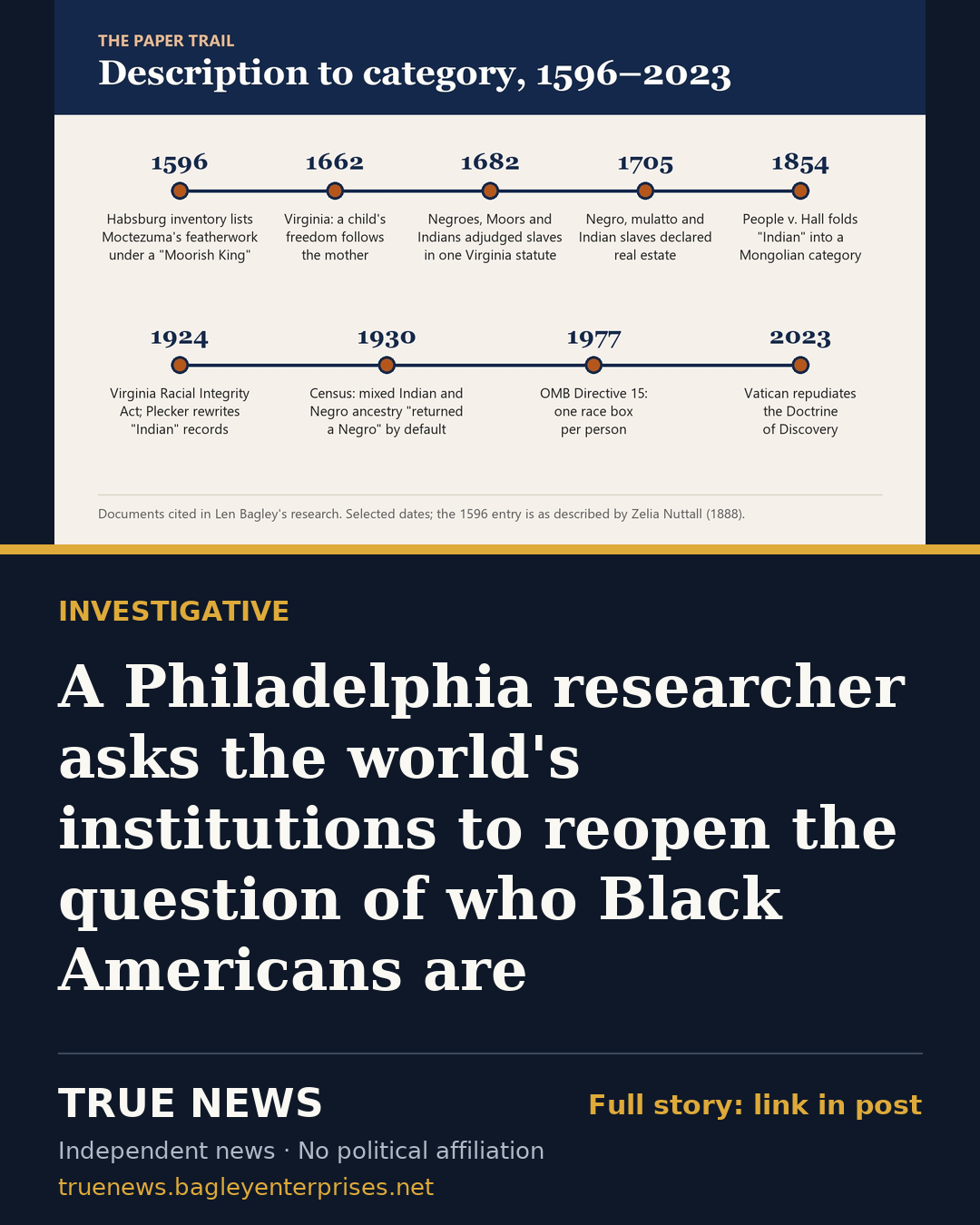
Bagley argues that the decisive move was not a single law labeled "reclassification." It was a sequence. Read alone, each statute looks technical. Read in order, they lock status, blood, baptism, marriage and finally property around the same groups. In Virginia, the path toward the comprehensive 1705 "Act concerning Servants and Slaves" includes, among others:
1662: Children follow the condition of the mother. Bondage or freedom is fixed by the mother's status, not the father's.
1667: Baptism does not free a person from bondage. Conversion no longer opens an exit.
1670: Free Negroes and Indians are barred from purchasing Christian servants, while still allowed to buy "of their own nation." Indians and Negroes are already paired in civil disability.
1680: Restrictions on assemblies, arms and movement of "negro or other slave."
1682: Negroes, Moors, mulattoes and Indians whose native countries were not Christian at purchase are adjudged slaves, and Indians sold by neighboring nations are slaves "to all intents and purposes."
1691: A ban on marriage between English or other white people and any "negroe, mulatto, or Indian," bond or free, with banishment as the penalty. The act uses "white" as a legal category and lists Indians in the same prohibited class as Negroes and mulattoes.
1705: The consolidated code. Servants imported who were not Christians in their native country are accounted slaves; Negro, mulatto and Indian slaves are held as real estate; and Negroes, mulattoes and Indians, along with "Jews, Moors, Mahometans," are barred from purchasing Christian white servants.
"None of those steps, by itself, is the whole story," Bagley says. "Together they put the machinery in place for what followed: who could be free, who followed the mother, who could marry whom, who counted as property, and which names sat in the same legal box."
He places the European catalogue history in the same century: the Habsburg inventory that used Moorish language for featherwork associated with an American sovereign and later framed it as Indian. He treats that as one formal renaming in a European collection, not a Virginia statute, but as evidence that the shift from older descriptive terms to "Indian" as an administrative label was under way in the same era the colonial codes were tightening.
Indigenous enslavement in the same codes
The same Virginia sequence did not only regulate African-status bondage. It repeatedly authorized and defined Indian slavery: war captives, Indians sold by neighboring nations and, by 1682, Indians swept into the same "slaves to all intents and purposes" frame as Negroes, Moors and mulattoes. The 1705 code then classed Negro, mulatto and Indian slaves together as real estate.
Bagley argues that the people taken under those Indian-slave provisions were described in the colonial record with the same dark, copper and tawny vocabulary used for the wider Indigenous populations of the region—not with the later Asiatic or "Mongoloid" typology that came to dominate federal and popular images of "Native American." The federally recognized category today, he notes, is a legal-political status built through recognition rules, blood quantum and tribal rolls. It is not identical to the descriptive baseline of the people the 17th-century codes enslaved under the name Indian.
"The codes show Indian and Negro locked in the same machinery," he argues. "The descriptions of who was being locked in do not match the phenotype story that was attached to 'Native American' much later. That is part of the reclassification file, not a side note."
The census as the national machine
Bagley argues that the largest reclassification tool was not a single state registrar. It was the United States census. Decennial schedules and enumerator rules sorted the population into official race categories nationwide. Families who had appeared under varying local or older designations were pushed into a smaller set of boxes—"Black," "mulatto," "Negro," later "African American"—while "Indian" was reserved for those who fit the government's criteria for tribal relation. That process ran in every state and territory, not only in Virginia or Louisiana.
The written rules show how the sorting worked. The Census Bureau's 1930 instructions to enumerators directed that "a person of mixed Indian and Negro blood should be returned a Negro, unless the Indian blood predominates and the status as an Indian is generally accepted in the community."
State actors such as Walter Plecker (Virginia, 1912–1946) and Naomi Drake (New Orleans) enforced the same logic at the birth- and death-certificate level, often overwriting "Indian" and forcing a binary. Bagley treats them as aggressive operators inside a national system whose backbone was the census: one set of federal categories, applied coast to coast, long before OMB Directive 15 made mutual exclusivity explicit for statistical policy in 1977.
"Plecker was real," he says. "Drake was real. The census was the machine that reached everyone."
The later chapters of his file sit on top of that foundation. He traces the vital-records regimes those officials ran; the 1854 California case People v. Hall, which folded "Indian" into a Mongolian-type frame for testimony; and, at the federal level, OMB Directive 15 (1977), which made race categories mutually exclusive for statistical and program purposes. Under it, "American Indian or Alaskan Native" turned on origins in the original peoples of North America plus maintenance of tribal affiliation or community recognition—a test Bagley argues many reclassified families had already been cut off from by prior record practice.
Bagley cites findings connected to H.R. 1294 (2007), which he reads as Congress acknowledging that records had been destroyed or altered in ways that impaired people's ability to establish heritage—an admission of informational injury. NAGPRA and related standing rules, written after these shifts, grant access through lineal descent or federally recognized tribes—rules that use the categories the shifts produced. "You need recognition to get standing; you need continuity in the documents to get recognition; Congress said the documents were damaged," he argues. "That is a closed loop."
3. Where that path ends
Administratively, he argues, a substantial share of the people moved out of aboriginal-status designations sit today under the labels Black and African American, kept separate from "American Indian" under the post-1977 federal design. That is the endpoint of the paper trail he tracks. It is not a claim that federally recognized nations have no indigenous history, and not a claim that every person under the Black label shares one origin.
4. The numbers and the DNA question
The Resolution Gap targets both consumer ancestry products and academic practice. Matching living relatives, Bagley writes, is comparatively checkable. Continent- and country-level percentages are model outputs against reference panels built from living people and from recruitment categories the companies and labs already use. Dual outputs appear in practice: high "African" percentages alongside relatedness maps that, for many testers with deep Southern roots, cluster in named U.S. regions and counties (Virginia, the Carolinas, Georgia, Alabama and related areas), not in dense webs of cousins living in West or Central Africa.
He argues that any fair genetic study must separate documented pre-1900 Southern and Mid-Atlantic lineages from recent African-born and post-1965 immigrant lines, rather than treating everyone under the modern "African American" label as one population.
He does not deny that studies report identity-by-descent segments between some African Americans and living West and Central Africans. He argues that those findings do not replace the test he is asking for: a transparent comparison of documented pre-1900 lineages from the reclassified population to ancient remains from the Eastern Woodlands and Southeast, with selection criteria disclosed and the option to return "undetermined." "If the story starts on the slave ship," he says, "the tool is aimed to end in Africa. Paperwork and match geography say the South. The percentage label is what gets treated as the last word."
On the scale of the Atlantic trade itself, Bagley's account of the Trans-Atlantic Slave Trade Database is blunt. He argues that the widely cited totals rest heavily on imputation—computer-filled fields where primary voyage detail does not survive. He points to analysis finding on the order of 78 percent of values missing across the database's fields, and to the database's own documentation classifying total-embarked and total-disembarked figures as imputed variables. "Imputation is what is done when the documents are absent," he writes. "No regression is required to read a manifest that survives."
He stacks that on constraints the same period documents: limits on deep interior operations for much of the trade's peak because of disease, including malaria, and logistics; African rulers who wrote that the trade was damaging their own societies and who restricted or refused it; and comparative volume—older trans-Saharan, Red Sea and Indian Ocean trades ran for centuries with interior access, yet published Atlantic figures run several times higher per century despite a harder ocean crossing. Historians note that Europeans often bought captives at the coast from African states and traders. Bagley's reply: a coastal market explains a mechanism; it does not, by itself, underwrite totals that triple or quadruple longer-established trades, especially when so much of the headline count is imputed. He treats imputation, comparative scale and those constraints as reasons the demographic story cannot be closed against the documentary reclassification sequence—or used to dismiss the missing ancient-DNA comparison.
5. Accountability
He wants institutions to answer the contact-era descriptions, the category laws, the destroyed and altered records, and the unrun DNA comparison together—not only with the post-reclassification label. On March 30, 2023, the Vatican repudiated the Doctrine of Discovery, stating that the old papal decrees "did not adequately reflect the equal dignity and rights of indigenous peoples." Bagley's synopsis lists concrete requests: open access to altered vital records and related archives; an accounting for records and remains missing from public custody; the ancient-DNA comparison; disclosure from testing companies on how reference panels are built and whether "undetermined" is allowed; and a clear answer on land titles that still trace to the repudiated discovery doctrine.
"Every step runs in one direction," he writes. "The record contains no systematic movement in reverse."
Forensic conclusion
Bagley's position is that the question is no longer whether a few records were messy. The contact-era descriptive baseline, the statutory sequence through 1705 and beyond, federal mutual exclusivity under Directive 15, congressional acknowledgment of destroyed or altered heritage records, standing rules that follow only the categories that survived, and an ancestry field that still has not run a transparent comparison of documented pre-1900 reclassified lineages against Eastern Woodlands and Southeastern ancient samples form a single chain.
Accounting, in that frame, is not optional. When the documents show people moved out of aboriginal-status categories, when Congress has noted impairment of the records needed to prove continuity, and when the decisive genetic comparison remains unperformed, answering only with the final label—"African American"—answers a different question than the paper trail raises. Equitable process requires the descriptions, the laws, the damaged records, the panel methods and the missing test to be faced together. Until they are, he argues, the official story remains incomplete by its own paperwork.
What the institutions said
The Smithsonian's National Museum of the American Indian replied that it does not have capacity for genealogical research; when Bagley reframed the request around methods and standards, it pointed him to collections processes and later said it lacked resources to fully address his questions. Mexico's National Institute of Anthropology and History said Indigenous and Afro-descendant identity is fundamentally a matter of self-identification and that the institute does not designate affiliations; it directed him to online archives and Afro-descendant research programs. Rep. Mary Gay Scanlon's office said the matter was not individual casework and pointed him to the Government Accountability Office and the Interior Department's inspector general, and said it had passed his concerns to the House Committee on Natural Resources. UN human rights offices sent an automated acknowledgment. Submissions aimed at BRICS-related channels produced no substantive reply True News could verify, and some messages were returned undeliverable. In March 2026 he sent formal notices through twelve UN missions; he reports no substantive response.
Where other researchers differ
Historians of the slave trade rely on the Trans-Atlantic Slave Trade Database for order-of-magnitude totals and attribute growth of the U.S. Black population largely to births after forced arrivals. They note that Europeans often purchased captives at the coast from African suppliers. Genetic studies report substantial West and Central African ancestry components and IBD with living African cohorts. Ancient genomes from the Americas are placed on a Native American branch as currently defined. Historians accept that officials such as Plecker erased Native identity for many families; the dispute with Bagley is over scale and over whether the longer statutory and federal-category sequence, plus the missing ancient comparison, support a substantial share of Black American lineages rather than particular communities.
Bagley's reply is methodological: imputed voyage fields are not counted people; ancestry percentages are not match geography; a coastal market is a mechanism, not automatic proof of totals that far exceed older established trades; recognition and NAGPRA standing follow categories built after reclassification; and the comparison of documented pre-1900 reclassified lineages to Southeastern and Eastern Woodlands ancient samples has not been run in the open. Until it is, he argues, treating the institutional genetic story as proof that the paper trail is irrelevant is aiming the tool and calling the aim a result.
What he is asking for
He says he is not asking any government to hand over land by slogan. He is asking for accounting: the descriptions, the laws, the damaged records, the panel methods and the unrun test, faced in one frame.
Related work, including The Unraveling and the international synopsis, is available on the same Academia profile. He says every claim can be checked.
Sources
- https://www.academia.edu/171850604/The_Resolution_Gap_A_Forensic_Audit_of_the_Genetic_Ancestry_Industry_Commercial_Academic_and_Institutional_Reference_Panels_Under_a_Single_Unresolved_Methodology
- https://www.academia.edu/172414965/SEPARATING_THE_AFRICAN_FROM_AMERICAN_A_Deconstruction_of_the_Misnomer_That_Is_African_American_
- https://press.vatican.va/content/salastampa/en/bollettino/pubblico/2023/03/30/230330b.html
- https://www.congress.gov/bill/110th-congress/house-bill/1294
- https://www.census.gov/programs-surveys/decennial-census/technical-documentation/questionnaires/1930/1930-instructions.html
- https://wonder.cdc.gov/wonder/help/populations/bridged-race/directive15.html
- https://www.slavevoyages.org/
Get stories like this every morning
The True News daily briefing: who's funding your officials, the economy in plain numbers, missing persons and community stories. Free, one email a day, unsubscribe in one click.
Republish this story
Newspapers, newsletters, blogs and community groups may republish this story free, in print or online, if they:
- keep the byline and credit it to True News, with a link to the original (included below);
- don't change its meaning (trimming for length and house style is fine);
- don't sell it on its own or add photos that aren't ours.
Photos and videos aren't included. Tell us where it ran: contact us.